
Farmers in Baringo County are now poised to reap better economic returns from their livestock, following an induction training on the adoption of hydroponic technology in the county.
The training, which was recently organized by the KCB Foundation in conjunction with the Miramar International College and Baringo County Government, saw at least 300 livestock producers undergo an intensive training on how to apply hydroponic fodder technology.
The new technology is expected to provide a durable solution to the recent drought, which has affected livestock farming in the county currently practiced by 88% of Baringo’s population.
It is highly expected that the adoption of the hydroponic fodder technology will help mitigate livestock mortality rates in the County, given that livestock keeping is the main economic backbone of Baringo. The project is in line with the County’s intention to increase food production, in addition to increasing fodder production for livestock. It is anticipated that in the long run, food security will be guaranteed for animals especially in times of drought.
According to a 2017 report by Konrad Adenauer Stiftung, approximately 4,442 livestock were reported dead in Baringo County between 17th December, 2016 and 23rd January, 2017, with their deaths largely attributed to the recent drought that rocked certain parts of the country.
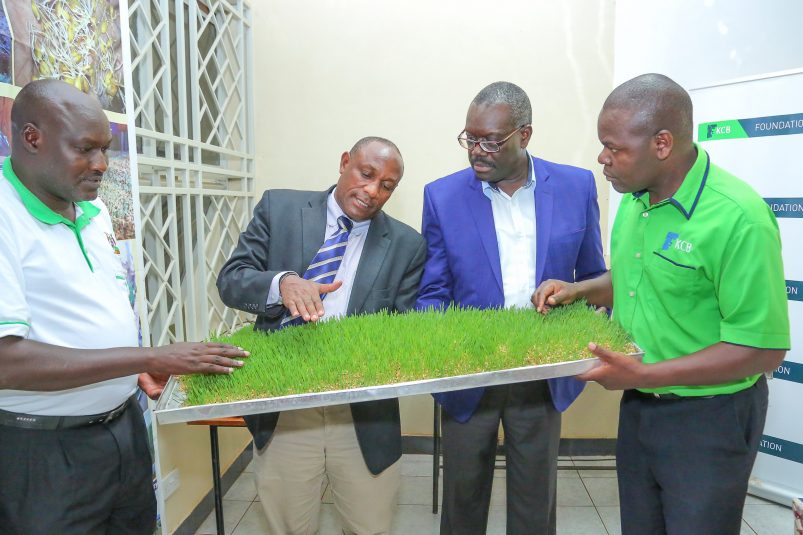
Hydroponic fodder is a livestock feed that is grown without soil. The fodder is grown on gravel, sand or simply a liquid and supplied with nutrients until it matures.
The large-scale production of livestock fodder by means of hydroponics offers a potential long-term solution to the problems of community conflicts over water and pasture, cattle rustling as a means of re-stocking after losses and even ecological degradation due to over-grazing.
With the adoption of this new technology, livestock farmers will be able to produce sufficient stocks of highly nutritious fodder, hence reducing livestock losses due to lack of fodder. Movement to search for pasture and water for livestock will be significantly minimized and the impact of large volumes of livestock on the environments will be moderated.
In Baringo County, agriculture and livestock farming is very critical to the economic develop of the county. If properly harnessed, the livestock sector can be central to elevating the economic prospects of the County. This will be done by properly mining the potential of the sector hence creating a huge opportunity for the thousands of poor smallholder livestock farmers, processors and marketers to rise out of poverty.
KCB Foundation intends to train farmers in at least 10 Arid and Semi-Aril areas on how to apply hydroponic technology, thereby significantly reducing the ravages of drought on their livestock.
So far, over 400 farmers from Narok, Kajiado and Marsabit Counties have undergone similar training.